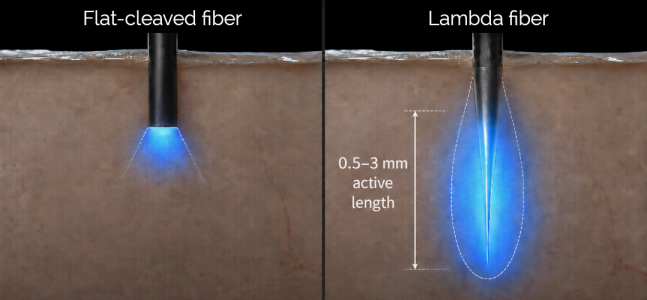
A conventional flat-cleaved fiber optically interacts with tissue primarily from its end facet. In contrast, a Lambda Fiber features a millimeter-long tapered section that gradually narrows from the fiber’s nominal diameter to a sub-micron tip. Light is emitted and collected along the taper sidewalls, providing an extended and uniform interface region that can be readily exploited by the neuroscientist for optogenetics and fiber photometry experiments across large brain regions.
Larger optical interaction volume along the taper when compared to conventional fibers More distributed illumination across extended brain regions, reducing local overexposure Potentially less localized tissue disruption due to smoother tissue penetration
One probe two experiments
A Lambda Fiber is not simply a glowing rod of light: the conical shape gives the fiber distinctive light-propagation properties, causing the optical modes traveling through the untapered portion of the fiber to be emitted at different positions along the taper. By controlling which modes are launched, the neuroscientist can control where along the taper light is emitted.
Full taper operation
Use the entire taper for large volume light delivery and collection. Plug-and-play with third-party systems matching numerical aperture and fiber size.
Spatial selective operation
Restrict the active region to a sub-portion of the taper for multisite experiments. Specialized optical control with GalvoStation or ThetaStation is required.
Flexible operation: can be used for full taper or spatial selective light delivery/collection Depth-selective illumination/collection without moving the implanted cannula Multisite access with a single implant, reducing the need for multiple fibers